The vocal gesture explained by Jean-Marie Legé
When Adeline Toniutti wrote her book Anatomie du Chant (The Anatomy of Singing), published in France and Russia, Jean-Marie Legé contributed to it. An osteopath to elite athletes, singers and opera musicians, he brought his scientific perspective to the vocal gesture as a whole. The Anatomie du Chant method is corroborated by 26 specialists in the body and the voice. Here are his contributions.
The breath, from the nose to the alveoli
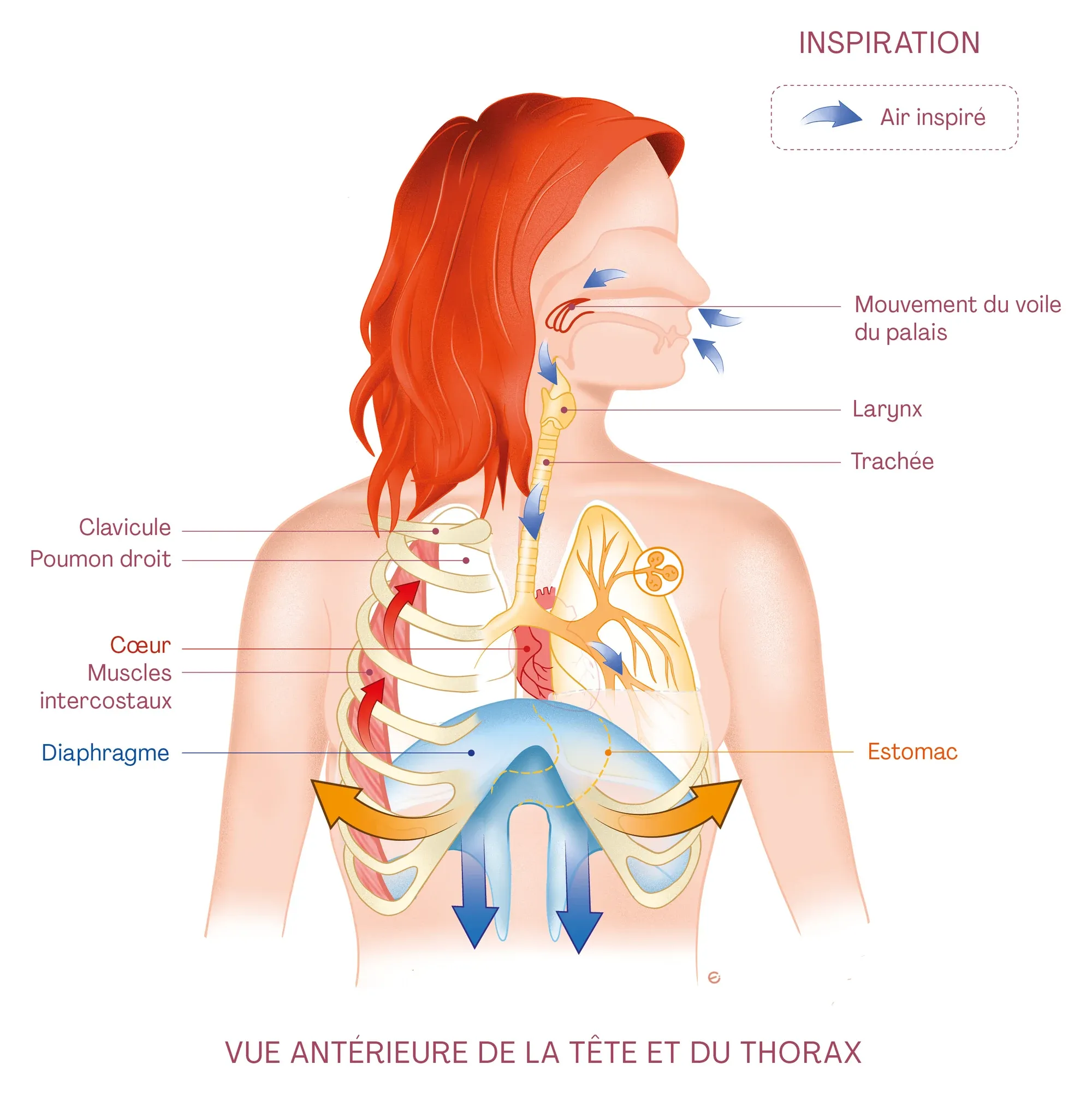
Inhalation, front view of the head and thorax. Anatomie du Chant, p. 63, drawing by Emma Blanc-Tailleur. Breathing in through the nose, out through the mouth
In singing, we will favour an inhalation through the nose and an exhalation through the mouth. […] When you breathe in through the nose, the stream of air arrives inside the body filtered and tempered. It has time to pass through all the upper airways, the nostrils, the choanae and the start of the trachea, without disturbance.
Jean-Marie Legé, in Adeline Toniutti’s Anatomie du Chant (Marabout, 2024), p. 64 Translated from the French. 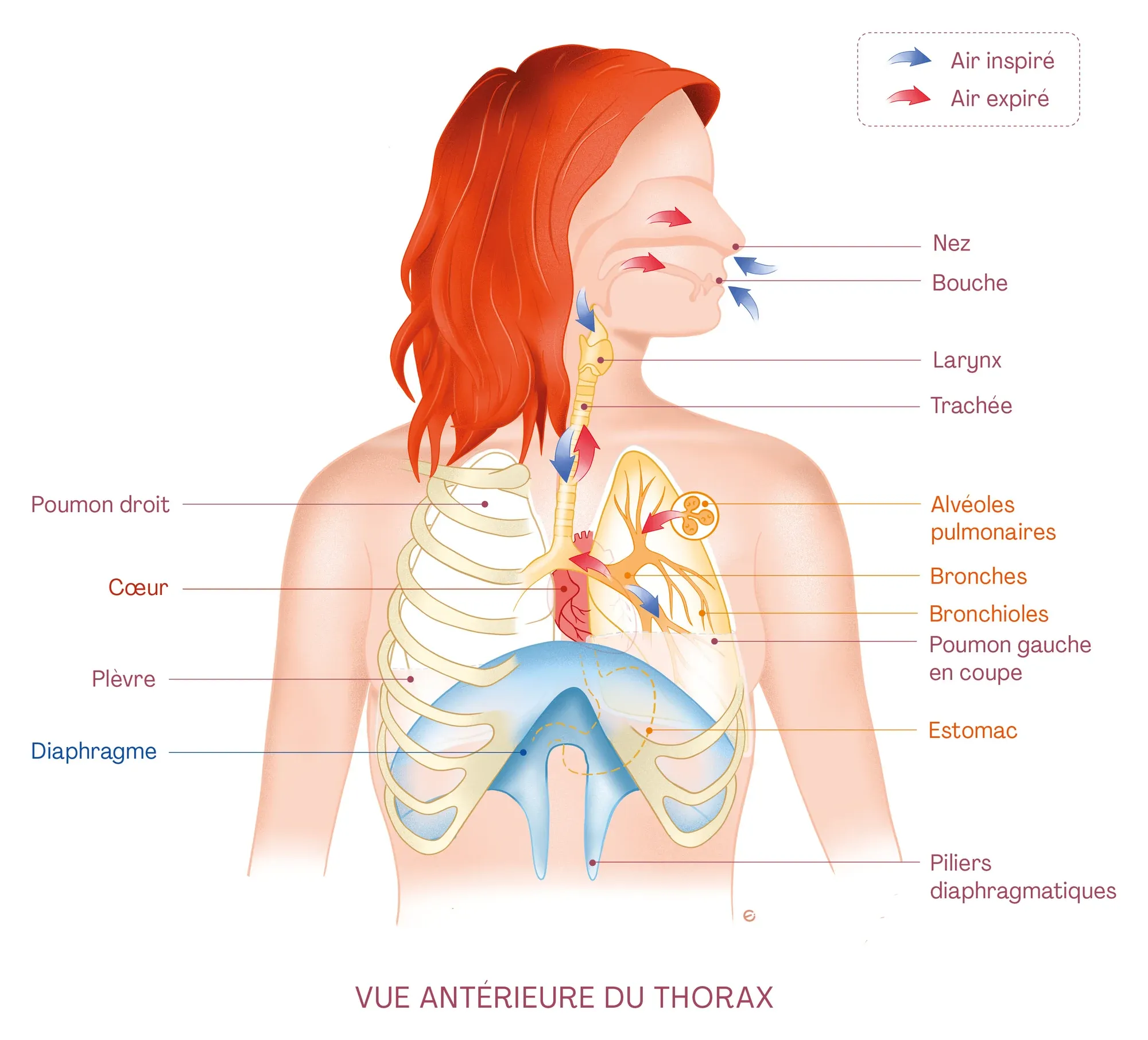
Front view of the thorax: the path of the air. Anatomie du Chant, p. 12, drawing by Emma Blanc-Tailleur. The route of the air to the pulmonary alveolus
Between the surrounding air and the pulmonary alveolus, the route through the airways is shared by the in-breath and the out-breath. The oxygen brought in by inhalation and the carbon dioxide released by exhalation create a buffer mixture in the airways. A series of successive breathing cycles is needed before the inhaled air reaches the pulmonary alveolus.
Jean-Marie Legé, Anatomie du Chant, p. 11 Translated from the French. 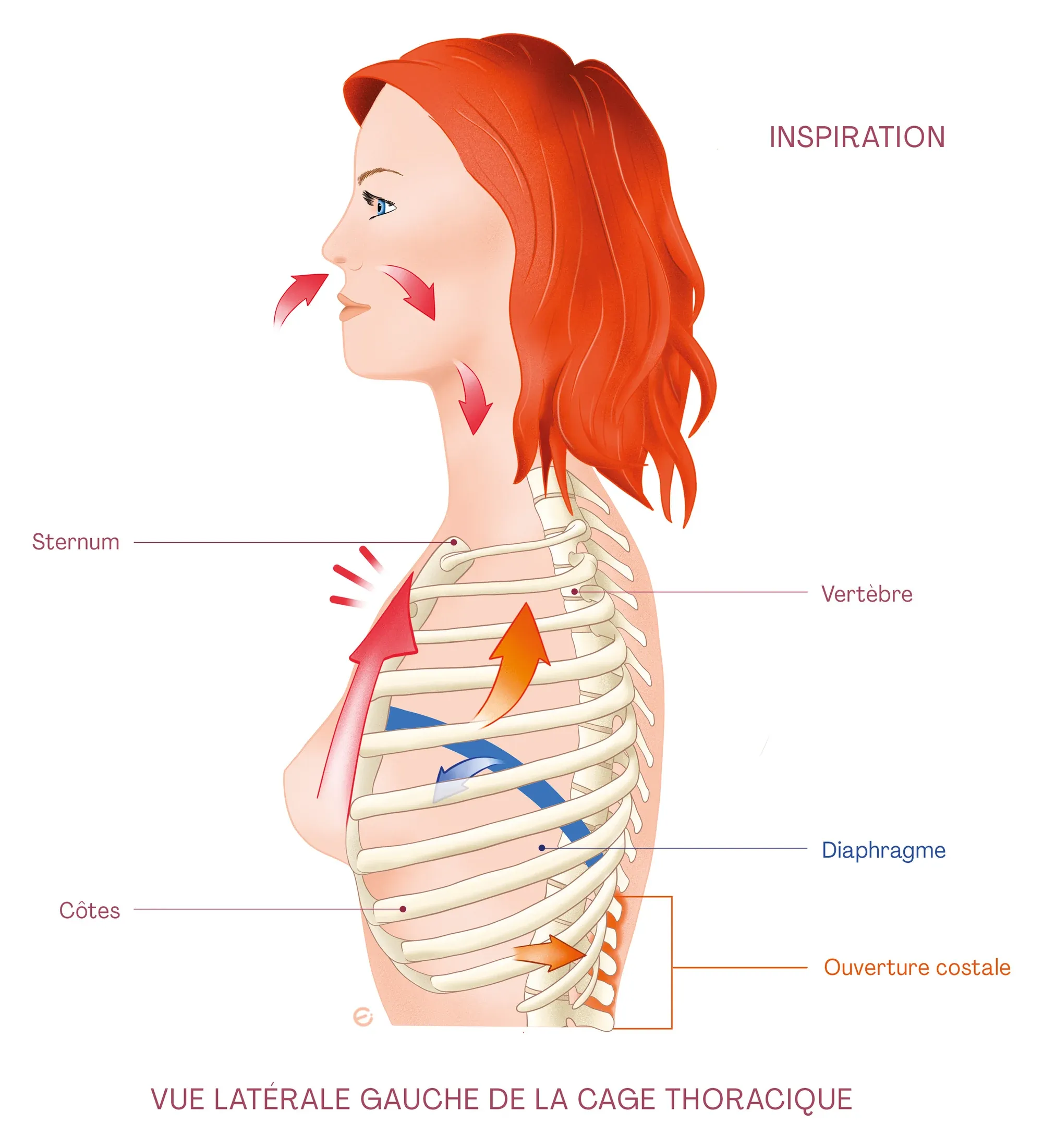
Inhalation, left lateral view of the rib cage. Anatomie du Chant, p. 16, drawing by Emma Blanc-Tailleur. The intercostal muscles and the movement of the ribs
The intercostal muscles lie in two muscular planes; their fibres are crossed. When one plane contracts, it draws the ribs together; when the other contracts, it opens the ribs out. On the in-breath, the ribs spread apart and lie more horizontal. On the out-breath, the ribs draw together and lie more vertical.
Jean-Marie Legé, Anatomie du Chant, p. 16 Translated from the French.


No obliques, no abdominals
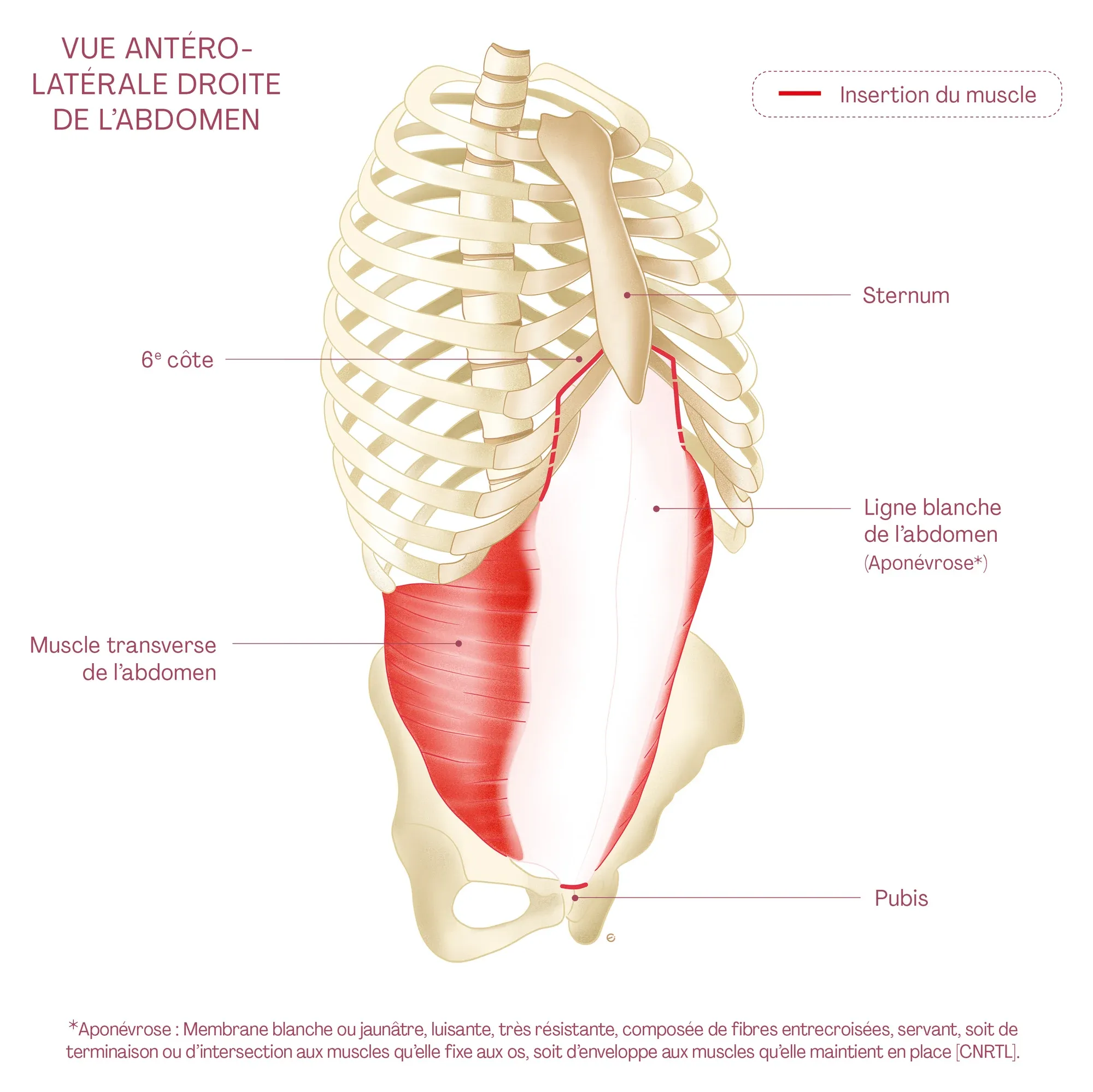
The transverse abdominal muscle. Anatomie du Chant, p. 21, drawing by Emma Blanc-Tailleur. The two layers of the abdominal muscles
[…] It is the obliques that give cohesion between the horizontal fibres of the transversus and the vertical fibres of the rectus abdominis. No obliques, no abdominals.
Jean-Marie Legé, Anatomie du Chant, p. 22 Translated from the French. 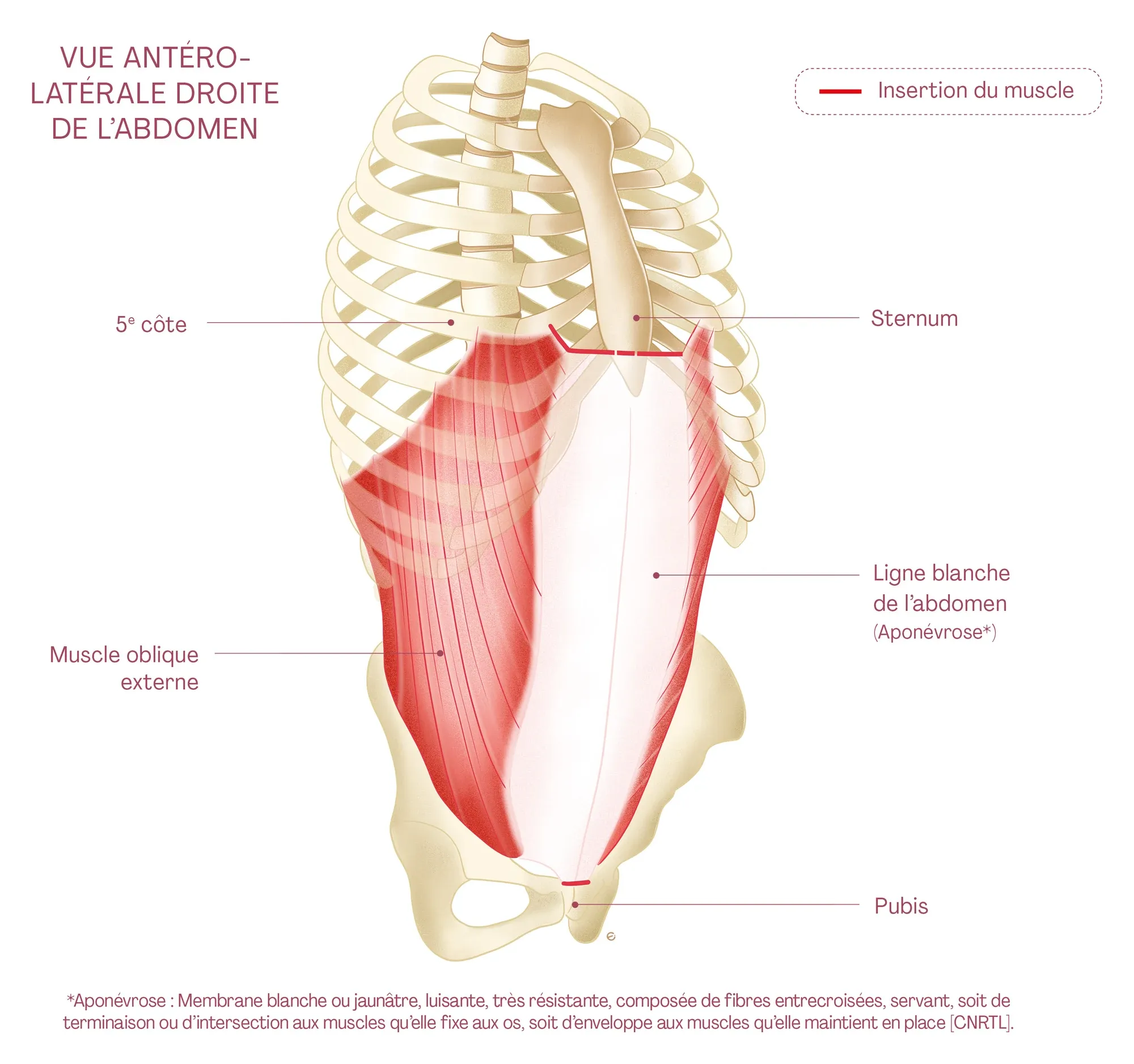
The external oblique muscle of the abdomen. Anatomie du Chant, p. 21, drawing by Emma Blanc-Tailleur. The obliques, engines of active exhalation
[…] The bracing of the oblique muscles therefore compresses the visceral mass and lets the diaphragm rise, forming a column of air. Without obliques, no active exhalation […]
Jean-Marie Legé, Anatomie du Chant, p. 67 Translated from the French. An abdominal muscle on its own has no strength
The active exhalation is achieved thanks to all the muscles of the abdominal wall, which contract, but which are held and tightened still further by the transverse muscle. […] It is the synergistic coordination of the obliques, the recti and the transverse muscle that creates the forces for the active exhalation. The support shifts from one muscle group to another. An abdominal muscle engaged on its own has no efficiency or strength.
Jean-Marie Legé, Anatomie du Chant, p. 69 Translated from the French. 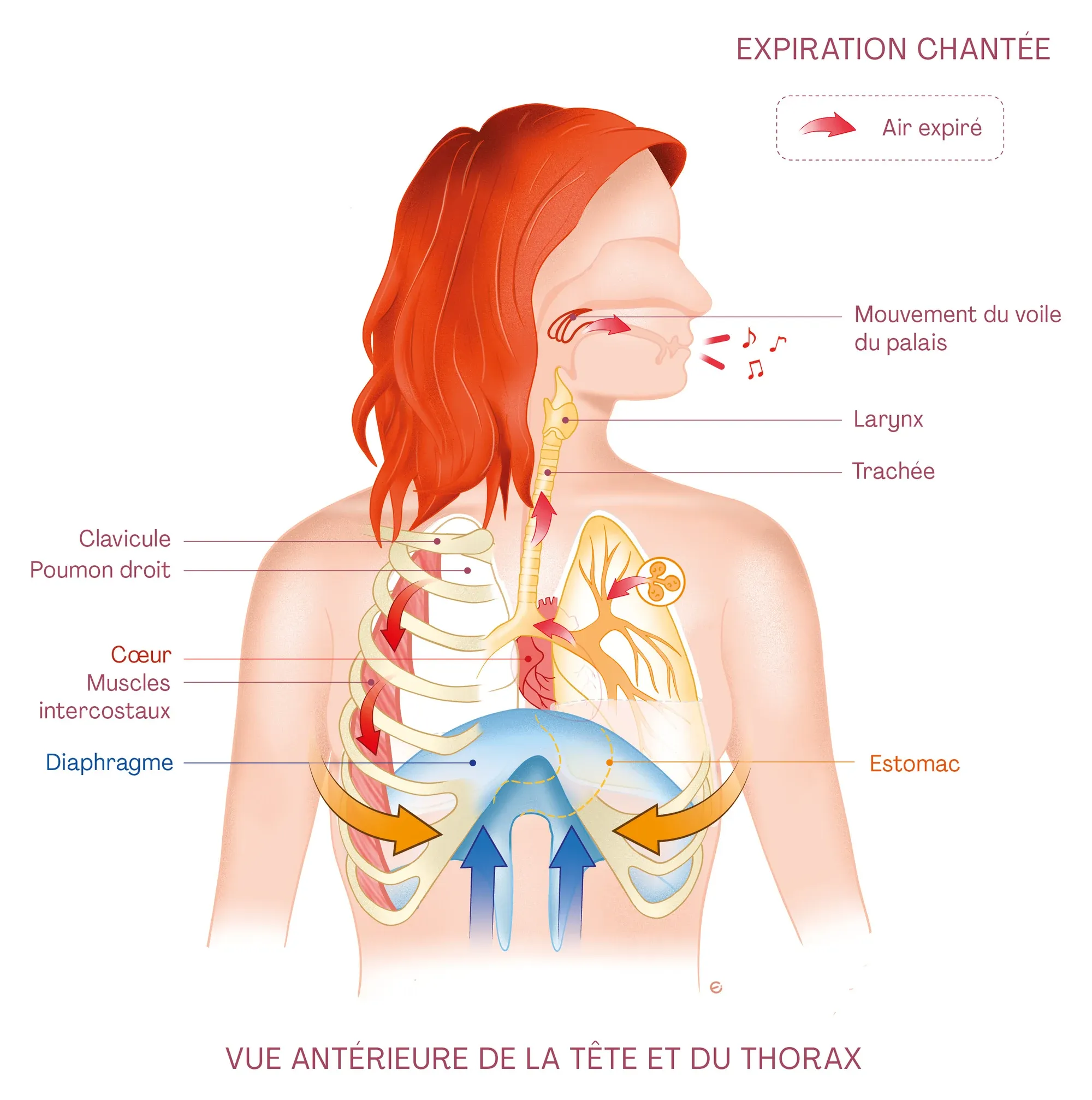
Sung exhalation, front view of the head and thorax. Anatomie du Chant, p. 68, drawing by Emma Blanc-Tailleur. Singing without pushing the belly out
Singing while pushing the belly out can cause a hernia, a bulge that escapes on one side or another. When breathing in, it is better to think of the expansion at the back, at the dorsal region of the floating ribs. If you think of filling here first, the rest happens naturally. The perineum is the counter-support of our inhalation […]. You have to remember to relax it: people who sing with the perineum clenched can lose efficiency. […]
Jean-Marie Legé, Anatomie du Chant, p. 70 Translated from the French.


The psoas, interlocked with the diaphragm
The psoas is interlocked with the diaphragm, in the very fleshy, very powerful part of the diaphragm. When I turn the leg, it relaxes at that level: the dome descends, the mediastinum is relaxed, and so the heart and the large respiratory and digestive ducts, and with them the throat, all relax.
The neck, the tongue and the jaw
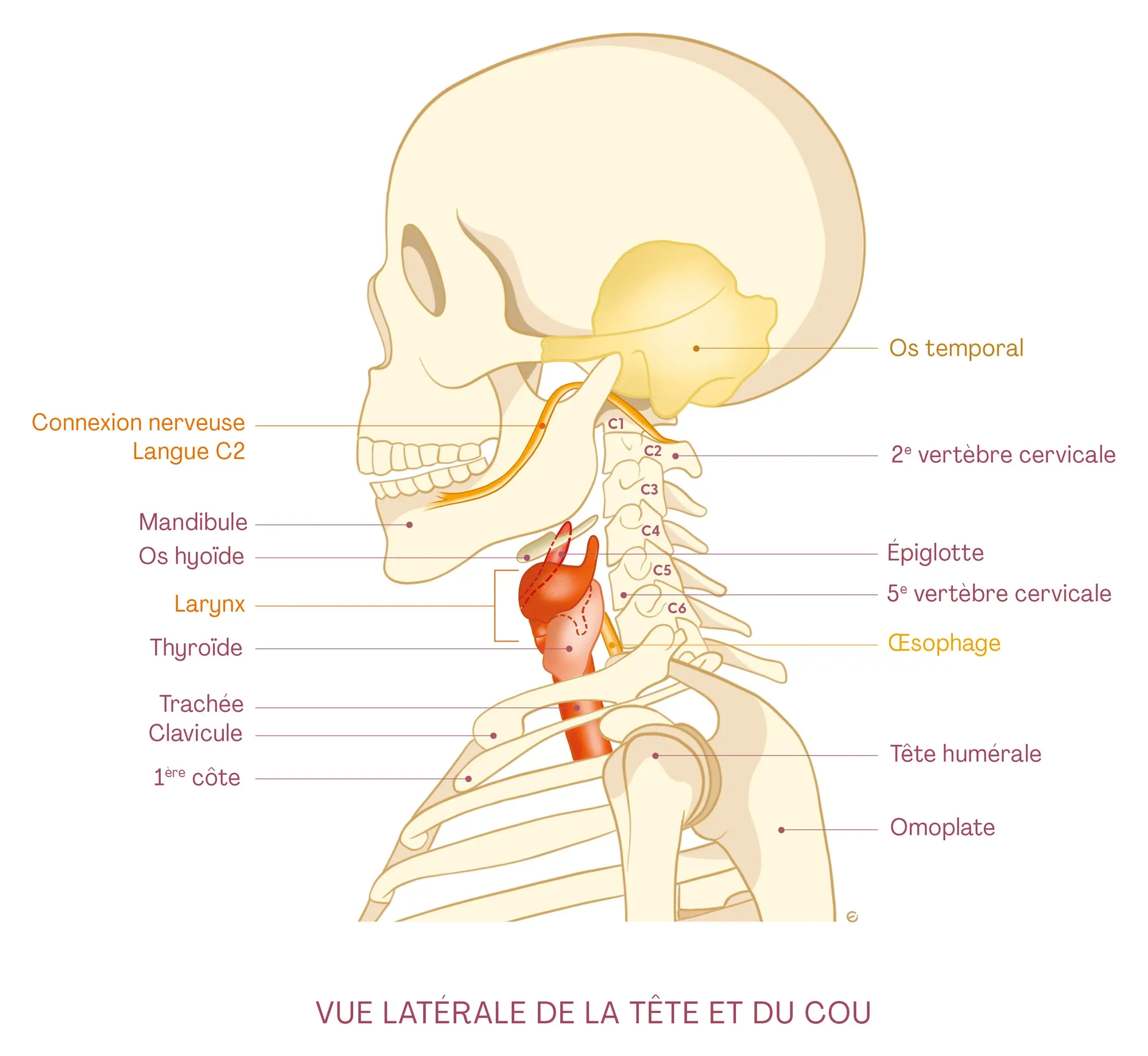
Side view of the head and neck, with the nerve connection between the tongue and the second cervical vertebra. A plate from the series drawn by Emma Blanc-Tailleur for Anatomie du Chant. The atlas and a “veiled” voice, a link seen in practice
The second cervical vertebra, the axis, has a tendon-and-muscle action on the tongue. I have observed that when the first cervical vertebra, the atlas, slips sideways, the patient’s voice becomes ‘veiled’ and tires easily. And yet there is no established relationship in the anatomical or physiological map.
Jean-Marie Legé, Anatomie du Chant, p. 47 Translated from the French. A veiled voice, or one that tires quickly, should first be examined by an ENT specialist or a phoniatrician.
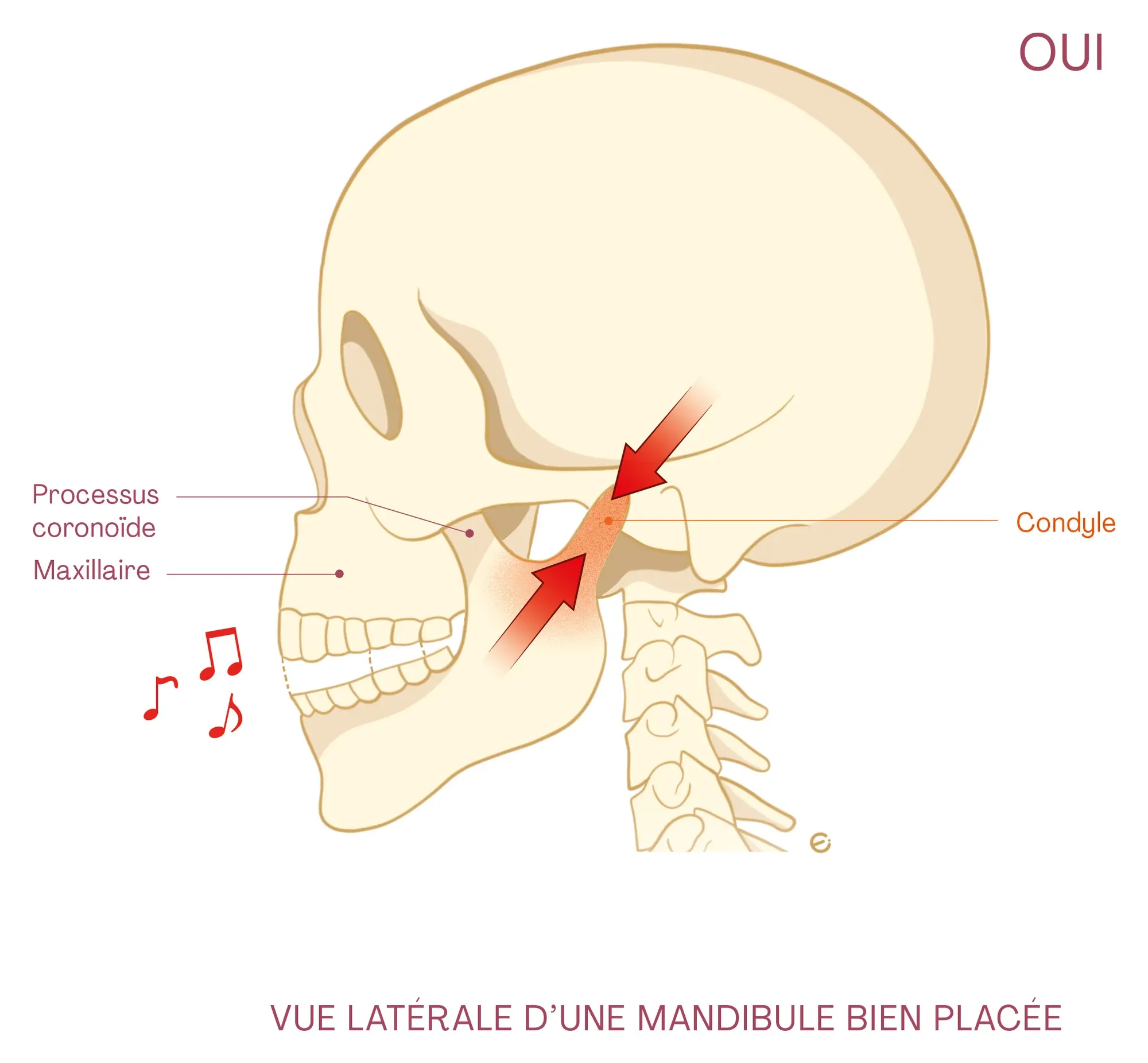
A well-placed mandible, side view. Anatomie du Chant, p. 80, drawing by Emma Blanc-Tailleur. Keeping the condyle “pinched” to guide the jaw
To build an optimal jaw movement when speaking or singing, you have to imagine the condyle moving closer in, ‘staying pinched’, as the osteopath Jean-Marie Legé puts it. You think of keeping it slightly under pressure to guide the jaw through its movements.
Adeline Toniutti, Anatomie du Chant, p. 81 Translated from the French.


Singing with scoliosis
For singers with scoliosis, which calls for medical follow-up, Adeline Toniutti quotes his phrase:
look for a dynamic balance within the imbalance.
Tone and conversation
In La Bonne Voix (The Right Voice), her book on the speaking voice and the art of public speaking, Adeline Toniutti devotes a section to her conversation with Jean-Marie Legé.
Tone reveals our emotional state
It’s the tone we adopt that says which emotion we’re in, and therefore the effect we want to produce. […]
Jean-Marie Legé, in Adeline Toniutti’s La Bonne Voix (Leduc, 2025), p. 135-136 Translated from the French. Benevolence can be heard in the tone
If you’re benevolent, it’ll be felt; someone who’s happy, you can feel it. […] Whether you’re going to be benevolent or malevolent, in your intention, it’ll be perceived in the tone you’re going to use.
Jean-Marie Legé, La Bonne Voix, p. 148 Translated from the French. Receiving as much as you send out, to avoid exhaustion
Conversation is like a quantity, a volume of flow: what you send out has to be roughly equal to what you receive, so that you don’t wear yourself out. […]
Jean-Marie Legé, La Bonne Voix, p. 85-86 Translated from the French.

A silent diaphragm exercise for stage fright
Adeline Toniutti asked him how to regain control of the diaphragm when fear dries the mouth, before speaking in public.
[…] what I advise is to breathe out fully, then to relax the abdomen before taking another gentle breath in through the nose, that’s always better and it’s more gradual too. And then, once the rib cage is inflated, breath held, to push on the belly, to make a big belly without breathing. Then you have to pull the belly in, still without breathing: that makes the diaphragm go up and down, the membrane of the diaphragm, and it lets us regulate, exercise control. […]
Do this exercise without straining, and stop if you feel dizzy. In the event of a hernia, pregnancy, high blood pressure, heart disease, glaucoma or recent surgery, ask your doctor for advice first.

The three roles of the nerve
He distinguishes three roles of the nerve: sensing, motor control and the trophic function, that is, the response to the body’s nutritional needs. For the trophic function, he takes the example of running:
When we run, for example, the foot needs a far greater rush of blood than when we are sitting at a desk. It is the nerves that allow an organ to quantify its needs. It is a network that runs autonomously.

Drinking ahead of exertion and long flights
According to Jean-Marie Legé, food makes up for an effort, whereas drinking has to come ahead of it.
The very dry air of an aircraft cabin also makes the body lose a lot of water, through sweat and through the moisture in the breath. For a long flight, he advises drinking a litre and a half of water on top of what you usually drink, in the six to two hours before departure, then continuing to drink during the flight.
This advice does not apply if your doctor has prescribed a fluid restriction.
Manipulating a joint is not the same as cracking it
Treating a joint by making it crack amounts to producing a release, rather like peeling off a suction cup. But a manipulation is a change in the axis of one part of the joint, and it is only rarely accompanied by a crack. When you make something crack inside a closed joint cavity, you produce the transformation of a small amount of liquid into gas, and it is this physical transformation that you hear. The after-effects of treatment are far more stable when there has been no cracking, but a true manipulation. […]
Jean-Marie Legé in Anatomie du Chant and La Bonne Voix
Anatomie du Chant, Adeline Toniutti’s book (Marabout, 2024), includes eleven “La voix des experts” (The experts’ voice) boxes signed by Jean-Marie Legé. Emma Blanc-Tailleur drew its plates, and Jean-Marie Legé fine-tuned them with Adeline Toniutti and the book’s doctors, through to the final version of July 2024. The book also quotes his remark on the sight of the horizon during convalescence (p. 188). The Russian translation, Анатомия пения (Bombora, 2026), includes his boxed texts.
La Bonne Voix (Leduc, 2025), Adeline Toniutti’s book on the speaking voice and the art of public speaking, quotes his advice on speaking and tone.

Anatomie du Chant

Анатомия пения

La Bonne Voix